Thursday, March 23, 2006

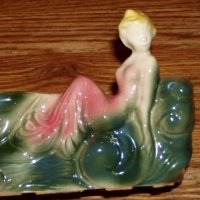
Brush Mermaid Garden Dish

mermaid detail
Gary writes:

Hello I was trying to id this pottery I have, I've seen one in a antique store like it they said it was McCoy, do you know what maker it is? Or is it McCoy? I would appreciate any help you could give me.


Hi Gary, it's not really McCoy, but Brush (a/k/a "Brush-McCoy"). It's not unusual for people to mix up the companies, because there were 4 generations of McCoys working in the pottery business in Ohio. The following information comes from the McCoy Pottery Collector's Reference & Value Guide by Hanson, Nissen, and Hanson, and The Guide to Brush-McCoy Pottery by Martha and Steve Sanford. So here's the story of Nelson, WF, JW, George, Nelson, Nelson, and Nelson.

In 1848, brothers W. Nelson McCoy and W.F. McCoy formed a pottery business in Zanesville, OH. They made stoneware crocks and jars.

In 1899, W. Nelson's son, James William McCoy, started the J.W. McCoy Pottery company in Roseville, OH.

In 1909, George S. Brush (who founded the Brush Pottery Company in 1906 in Zanesville) became J.W. McCoy's general manager.

In 1911, the two potteries merged to become the Brush-McCoy Pottery company. J.W. McCoy continued to be a principal stockholder until 1925, at which point the company was renamed Brush Pottery.

In 1910, Nelson McCoy (J.W.'s son), along with help from his father, formed the Nelson McCoy Sanitary Stoneware Company in Roseville, OH. Nelson McCoy's wares competed directly with those manufactured by Brush-McCoy. In 1933 this company reorganized to become the Nelson McCoy Pottery Company. After Nelson McCoy died in 1945, his nephew Nelson McCoy Melick became president, and remained president until his death in 1954. At that time, Nelson McCoy Jr. became president. In 1967 the pottery was sold to Mount Clemens Pottery Company, and in 1974 it was sold to Lancaster Colony Corporation. Nelson Jr. remained president throughout that entire time and the pottery was still known as "McCoy." Nelson Jr. Left in 1981, the pottery was sold to Designer Accents in 1985, and they were out of business by 1990. Pottery from this NelsonX3 company is what is known to collectors as "McCoy."

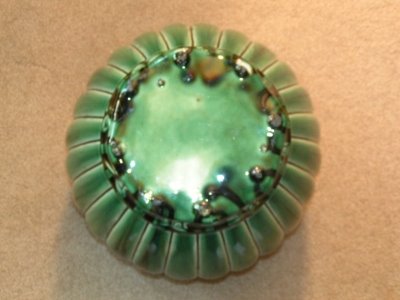
So, on to your planter. It is a #912 garden dish that was made in 1956. Brush made a whole line of garden dishes like that in the 1950's: the ones I see most often are a bear, raccoon, or squirrel on a log, but there are others with seahorses, puppies, birds, etc. Not only is the paint style and quality similar throughout the line, but the real give-away is the bottom of the planter: all of the planting dishes I have seen from that line have the same pattern of unglazed rails on the bottom: turn it on edge and it's shaped like an "E" or a "3."

Sanford's Guide to Brush-McCoy Pottery Vol II lists the value as $60-70 (1997 price guide). Their values tend to be a bit high (especially since I live in the Midwest), and I think the greater availability of stuff on eBay has pushed pottery values down even further. The same authors list the bear or raccoon on log from the same line as $50-60, but I see these in antique malls here in the Midwest for around $12-25. There are several of the animal-on-log planting dishes for sale on eBay right now (search for "log" under Brush-McCoy pottery; there's a bear, squirrel, rabbit, and raccoon), so you might want to monitor what they sell for. Your mermaid is probably worth around 20% more than those, because it's prettier and harder to find.

Wednesday, March 22, 2006

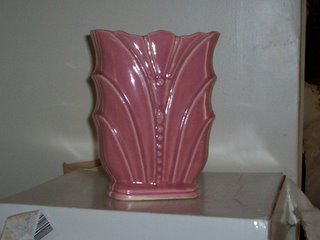
American Art Potteries (Morton) Vase

Tamra writes:
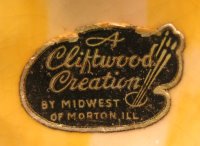
Can you tell me any more about the American Art Potteries vases I have, of which I have included some photos? I bought them at a second hand store several years ago because I loved the color combinations, which remind me of the 1950’s. Luckily, one of the vases had the American Art Potteries Norwood sticker remaining. I really haven’t had much luck finding any information on them except for the basic info and chronology of Morton Pottery/American Art Potteries. Apparently, these pieces would have been made between 1947 and 1963. The stickers on the bottom are original price tags reading “1.25”. There are no other identifying marks on the bottoms. The vases show extensive crazing, as you can see on the photo of the sticker. I have found this to be part of their charm though, I suppose, it affects the value of the pieces. I would appreciate any further information you could give me about these pieces.
Norwood vases
Well Tamra, unfortunately your vases are not pictured in the Morton book I have. I have no reason to doubt your ID of them: the sticker is right and the glaze looks right for that pottery, but it looks like I won't be able to give you much more info. In general, vases from the Morton potteries seem to be valued at $15-25 range, more if they're really big or really fancy, so at least that gives you a ballpark figure. I really like their clean lines and their different glazes: they are lovely!

Sunday, March 12, 2006

Weller Jardiniere

Christy writes:

This planter is 12" high; the mouth is 12" wide & the base is 7" wide. It belonged to my grandfather. There are no markings on the bottom. Do you know who made it & about how old it is? Thanks!

This beautiful jardiniere is found on page 141 of "The Collector's Guide to Weller Pottery" by Sharon and Bob Huxford. The description is "Colored Glaze Jardiniere, 10", no mark, $150-200" (prices are from 1996). Although you note your piece is 12" across, the picture is identical otherwise.

Weller opened in 1872 and closed in 1948. Based on the coloration, it was probably made sometime between the 1920's and the time the plant closed.

Peter Peter Pumpkin Eater Cookie Jar

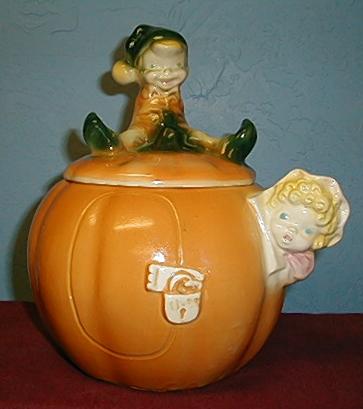
Wow, two Brush Twin-Winton cookie jars in a row! I got this photo and an e-mail from Dorie:

I have a Cookie Jar made by the Brush-McCoy Pottery Company.
I hope that the attachment works.
It is Peter Peter Pumpkin Eater, with the marking on the bottom "W24" "USA".
It is in excewllent condition, a little crazing on the bottom and the inside bottom, which comes with age.
I have search the internet for information and found nothing.
Finally look in a collectable book and found it, but would like a little more information, can you help me?


Well Dori, it looks like you already have the bulk of the information already, so I can only add a little bit more. Like the Formal Pig described in my last blog entry, Brush's Peter Pumpkin cookie jar was designed by Twin Winton, two brothers who did freelance design for lots of different potteries. It was made in 1959, and in 1996-97 its value was listed at $250-400 (from Sanford's Guide to Brush Pottery Vol I). I haven't found others for sale to be able to verify a more realistic price, but there is currently one up for sale on eBay.

I should probably point out for you and for the last poster that I am not a cookie jar expert, so I don't know which jars have been reproduced and/or how to spot a reproduction. I found on about.com that many Brush cookie jars are known to have been reproduced (including the Formal Pig :( ), but I didn't see this one on the list.

Friday, March 03, 2006

Brush Formal Pig Cookie Jar

pig cookie jar frontpig cookie jar bottomAllison sent me some photos of a cookie jar and wrote:

For years I have had a 'ugly' pig cookie jar in my collection. Recently, I decided to start researching to see for sure what it was that I had.

While doing an internet search, I learned about Brush-McCoy Pottery. In looking through pictures of their cookie jars, I found my 'Formal Pig Green' cookie jar. However, the markings on the bottom of my cookie jar does not match up to any of the marking listed for either Brush or McCoy Potteries.

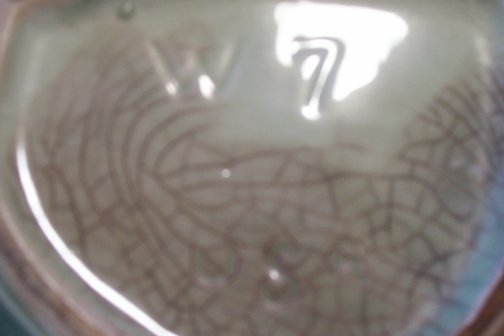
The markings on my cookie jar are : W 7 and USA. The measurements are approximately 12 inches tall, by 8 inches wide.

Any information you might be able to give me would be greatly appreciated.


Hi Allison, I don't really know much about collecting cookie jars but I do have some of the Brush reference books and I see your pig (the one in the book has a black outfit instead of green, but otherwise looks the same) in Sanford's Guide to Brush-McCoy Pottery, Book 1. The book lists the mold number as W7 (same as yours), and they say that it was made in 1954. The reason the mold number begins with a W is because the cookie jar was designed by Twin-Winton (twin brothers Don and Ross Winton). They designed pottery on a free-lance basis for many of the pottery manufacturers of that time.

The latest price guide I have for that book is 1996-1997, where it is listed in the value range of $190-390. I found a recently completed auction for one on eBay that only went for $53 (he had a chip on his nose), and a listing on another site where they were asking $250, so that gives you a range for the values.

Wednesday, March 01, 2006

St. Louis Style Pizza (a/k/a "Pizztata")

I have been meaning to write about St. Louis style pizza. Ha! I bet you didn't even know St. Louis had a pizza style!

St. Louis style pizza is made with thin crust, cut into squares instead of wedges, and it uses a weird cheesey-food-thing called Provel (yes, capitalized!) instead of mozzarella. Wikipedia says it is almost unknown outside of St. Louis and was invented here specifically for pizza, since someone thought we needed a pizza cheese that melts well without the wonderful stringiness of mozzarella that makes biting into a hot pizza so messy. Other sources say that Provel is kind of like the Velveeta of white cheese: a processed blend of provelone, Swiss and cheddar.

Probably the best-known St. Louis style pizza comes from a local chain called Imo's, but it might not be the best ambassador of St. Louis style pizza. In fact, Doug hates it! Their crust is so thin and crispy that it's more like eating a giant tostata than a pizza, so we have dubbed it the "pizztata." Imo's cooks it until the cheese is a scary brown color. The first time I saw an ad for them I thought maybe they just didn't have an A-level photographer taking a picture of their pizza and that it got burnt or something, but I later figured out that their pizzas actually look like that. How do they taste? They're ok but not very satisfying, even for someone like me who prefers thin crust. It didn't help that the one time I ate at one of their restaurants (the other time we had it delivered), it wasn't exactly a clean and inviting place, and the staff's mood floated somewhere between apathetic and surly. Granted that was only one restaurant, but it didn't impress me.

If you want to try a St. Louis style pizza, I recommend Fortel's. Not only was their pizza filling and good, but offer a wide range of toppings so you can get something interesting (like a Reuben or BBQ chicken). They had sauerkraut! Disgusting, you say? Not at all! Sauerkraut is something I have never liked, and fortunately my German mother didn't think it necessary to force us to eat it. But a long time ago Doug made me try a Canadian bacon and sauerkraut pizza (maybe that's a Kansas City thing, who knows) and I've been hooked ever since. Yum!

Monday, February 20, 2006

Dog & Basket Planter

Red dog planterMarykay sent an email about the green dog planter on my unknown animal pottery page. She has the same planter in a dark red color -- which may provide another clue to its maker -- and was nice enough to send me some pictures.

At least three of potteries I collect used a wine red glaze: Shawnee, Camark, and Morton. I'm sure there are other potteries that used a similar glaze as well (I have several dark red pieces from an unknown pottery), but those are the big three I know of that have a fairly unique glaze color.

Bottom of Red Dog Planter If this is one of those three I would probably guess Morton, although it would only be a guess. The Shawnee red glaze is shinier and a bit more transparent, and the red is deeper. The Camark red is deeper yet (and is one of the prettiest colors I've seen). It's hard to tell exact color when viewing a digital picture, but the glaze does seem to have the same characteristics as some Morton flower pots I have packed away somewhere. Or it could have been made by an entirely different pottery, one for whom we haven't found an identification book for yet. The unglazed bottom also makes me less likely to think it's Shawnee or Camark.

Thanks for sending the pictures Marykay!

Monday, February 13, 2006

Missouri Organic Association Conference

Doug and I traveled to Jefferson City Saturday for an organic conference. We learned a ton about farming and about the state of organic farming in Missouri, and got to meet a lot of nice people. Although I don't farm, I have a deep interest in the organic industry as a whole, I buy much of my food organic (when the prices aren't unreasonably high), and I keep my yard organically. Several farmers gave talks about their business, clever solutions to different setbacks (many of the setbacks seem to come from being small, not from being organic), and the markets for their goods. One thing that struck me was how practical most were (I LOVE being back in the Midwest!).

I heard multiple times that "profit is not a dirty word," and a couple of farmers even came right out and said they wouldn't farm organically if they couldn't make a profit. These guys didn't strike me as greedy, and they weren't wearing expensive clothes and jewelry, or driving expensive cars -- they are practical people that realize to make any business work, you have to make a profit or your money runs out and you have to do something else for a living. Many do not appear to put profit above all else (unlike so many large businesses), just high enough so they can keep doing what they love, and live the way they want to live.

The talk about profit encouraged me much more than any talk of idealism could have. While I repect the idealism involved with organics and even share some of it myself, idealism can not make crops grow, and it can not advance the science enough to make organic a standard, approachable way of doing things. Those of us who only have a yard to keep can be organic through benign neglect: not so for the farmer.

I especially appreciated listening to Keith from Super Gro of Iowa, who broke down each section of a soil test and told us what each part meant. Many labs will tell you "add
nitrogen" or "add lime," but without a good understanding of the entire balance of nutrients in the soil those recommendations can be dead wrong. If you've been organic for awhile, it won't surprise you to find that the reading for nitrogen (the "N" in N-P-K) isn't all that important; newcomers would probably be confused to find that the speaker just blanked out the entire nitrogen section of the report. If everything
else is where it needs to be, there will be enough available nitrogen to grow crops.

It surprised me a little to find out what kind of prices are being offered for organic crops: often several times more than for their non-organic counterparts. Although I'm used to seeing higher prices for organic food in grocery stores, it's nice to know that some of that gets back to the farmer. Expenses like storage and shipping take out a much larger percentage of the bottom line for a small farm. Unlike conventional agriculture, organic agriculture is still an industry where supply and demand determine the prices and production quantities. Right now, demand far outpaces supply. Those who can afford to pay a little more for organic are helping to keep the demand high; if everything works the way it should (meaning if the gov't lets the market work the way it should instead of letting special interests manipulate it like with conventional ag), supply will eventually catch up and we consumers will eventually enjoy lower prices.

Click here for more information about Missouri Organic Association.

Monday, January 23, 2006

Madonna and Child Planter

Madonna and Cherub PlanterHere's another mystery piece from Jim. When I see a Madonna planter (or Mutter Maria as my mother calls it), I usually think Haeger, and this looks to be a Haeger mold #3264 "Madonna with Cherub Child" planter. It's 11 inches tall, and was originally marked with a foil label which is why there are no markings on the piece.

I found it on page 284 of Dilley's Haeger Potteries Through the Years. Book value is $20.

If you have a planter or vase with a completely glazed bottom with three dots where the piece sat during firing, that's a good hint that it may be Haeger. The apparent crease I see in the photo threw me off, but I think it's just a trick of the lighting. Usually the bottom is flat.
Madonna and Cherub Planter Bottom
The satin white finish was fairly popular on Haeger pieces, as well as Hull, Redwing and other American potteries. Haeger made several other Madonna planters as well, and I have only seen them in that finish.

Sunday, January 22, 2006

Pink Vase

I got a note from Jim with pics of three unidentified pottery pieces, a vase and two bowls. I didn't think I'd have much chance of identifying the bowls (not something I collect, so not so familiar with them), but I thought I knew who made the vase. Boy was I wrong.

Jim thought the vase might be McCoy, but was unable to locate it in any reference books. From the first picture, I agree: I sure does look like a piece of McCoy.
pink vase

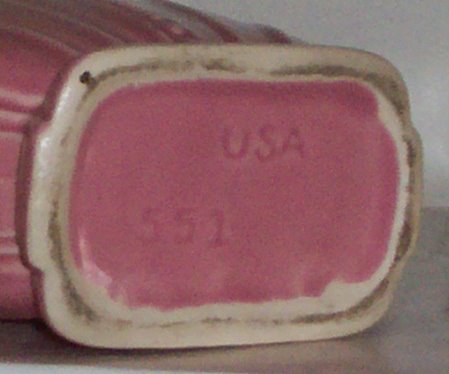
However, looking at the bottom of the vase I was no longer so sure:

pink vase bottom


We looked in our McCoy books but haven't had any luck finding it. The color looks a little bit like Brush (although Brush often has a larger S in the USA) but no luck finding it in those books either. For kicks, we also checked Morton (their look is inconsistent, so you never know), American Bisque (wrong coloration, but who knows?), Shawnee (the mark didn't look right, nor did the color), Watt, Camark, Muncie, Niloak, Robinson Ransbottom, and almost every other book we had.

So I'm stumped. When I see pieces that look as detailed as a McCoy but other parts of the design (like the mark) don't mesh, Ungemach Pottery is a possiblity. Fred Ungemach did work for McCoy (and his wife worked for Brush) before founding his own pottery, so there are extensive similarities. Unfortunately, there aren't any reference books for Ungemach so if it's not marked UPCO then there's no way to tell.

Friday, January 20, 2006

Recipe: Rice Porridge


I'm not a gourmet cook. I'm way to lazy for that. But I like to eat. One of my favorite dishes to get at a Vietnamese restaurant is the rice porridge. Not all the restaurants have it, and sometimes it's only available on the weekends. But I crave it all winter!

I have had the soup with fish, and another restaurant serves it with a variety of meats (shrimp, pork, and chicken). It's good even with no meat at all, and if you're watching your weight you will enjoy that the porridge is thick and creamy without the added fat and calories of actual cream. The only addition to the soup that I consider to be mandatory is freshly sliced ginger root. I would say to julienne the ginger since you want the pieces to be shaped like matchsticks, but I think julienned is way too big (any foodies care to help me out and tell me what this cut is called?). Make the pieces really thin, and 1/2 to 1 inch long.

I won't make any claims about the "authenticity" of my recipe. Like I said, I'm too lazy to worry about things like that. All I know is it's easy to make (but messy! the rice will boil over even if you use a large stock pot) and I really like it.

Rice Porridge

1 cup brown rice
8 cups water
~1/8 - 1/4 cup thinly cut strips of ginger root

4 green onions, sliced
4 cloves garlic, sliced
salt
2 tsp. sesame oil
bean sprouts
fresh cilantro
more ginger strips

Combine the rice and water, cover, boil for about 1-1/2 hours. Throw in the ginger toward the end of the cooking time. You may need to add more water as the rice cooks down to maintain a thick soupy consistency. I ended up adding about 2 more cups to mine. Regardless of what you put in the soup, you will probably need some salt.

Sautee the garlic and the whites of the onions in sesame oil with a little salt. I like them cooked until they're brown: this would probably be considered "burnt" for most purposes but it tastes good with this soup. Spoon the porridge into bowls and sprinkle the sauteed mixture on top. Garnish with bean sprouts, cilantro, and ginger to taste. Enjoy!

If you're counting "Points," I estimate that the entire recipe is about 14 points: 12 for the rice, plus 2 for the sesame oil. Depending on how much water you add, you'll end up with 6-8 cups of soup.

Thursday, January 19, 2006

We're still alive and have all our teeth!

Doug and I went ice skating last night with a friend of his from work. Doug hasn't attempted to ice skate in oh, about 30 years (longer than that friend has been alive!). I tried it once when I was a kid, but it was on borrowed skates that were too small, and on a flooded baseball diamond (that's what they did up in Wisconsin), which made for a rough surface. Needless to say, I wasn't very successful.

There is also the Texas mindset that I need to get out of. I feel that if the weather is cold enough to freeze water solid, especially solid enough to walk on, it just seems smarter to spend the evening curled up under a blanket with a nice glass of brandy reading a good book or watching tv.

Both of us did a lot better than we thought (feared) we would. We didn't fall at all, although Doug does have a nasty blister on his ankle. I haven't done much roller blading lately, but I used to do it a lot and found ice skating to be a lot like that. One difference from my prior experience might have been the skates themselves. My first try years and years ago was with figure skates with leather boots, and my ankles weren't strong enough to keep me upright. We rented hockey skates last night, which are stiff-booted and provide a lot more ankle support.

The skating rink had weird taste in music: a radio station that plays all '70s tunes. I asked Doug's friend if that was just to please the old folks on weeknights, but he said they always play that. Scary thing is, I knew most of the songs. Among the musical artists were Meatloaf, ELO, the Doobie Brothers, Donna Summers, and the Bee Gees. Wow.

Tuesday, January 17, 2006

Recipe: Red Pepper Dip

We found a Greek restaurant that serves a wonderful red pepper dip. I don't have their recipe but have been able to come up with a reasonable representation of the dip on my own.

Red Pepper Dip

2 red (or orange) bell peppers, diced
9 cloves garlic, peeled, cut in 1/2
3 oz. feta cheese
olive oil

Put the peppers and garlic in a casserole dish and drizzle with olive oil. Toss to coat everything evenly and roast in the oven at 450F. After some of the pepper and garlic tips brown, add 1-2 tablespoons of water, put on the casserole lid, and let it cook covered for awhile to further soften the peppers. Total cooking time was about 30 minutes in a convection oven... for a standard oven it might take somewhat longer. Don't salt the pepper-garlic mix: when you add the feta cheese the dip will have a salty taste.

Lightly process the roasted mixture, along with any liquid it generated, in a food processor or blender, just enough to break up the garlic cloves and the pepper pieces a bit. Mix in the cheese. If the mixture is too dry, add a little olive oil.

Serve with pita slices. Yummy!

Optional: you can sautee the peppers and onions on the stovetop instead of roasting in the oven. This method will require more olive oil since any liquid generated during cooking will likely evaporate.

Friday, January 13, 2006

Cat Motivators

My favorite posts over at This Blog Is Full Of Crap are usually the "Ask the Cats" ones, and Laurence certainly didn't disappoint with this one. He has hooked us up with a Flickr tool to create motivational posters featuring your cats (or anything else you please). Here are mine.

Sienna:


Felix and Casper:


Create your own posters here.


Paperwhites!


I love plants, but this is the first time I've ever forced bulbs indoors. Probably the main reason that I haven't done so before now is that I never remember to water. The only houseplants that stand a chance with me are desert plants, or plants that are so huge they can go for a month with very little moisture.

Our new house has a perfect place for smaller houseplants; there's a large window over the kitchen sink with a windowsill deep enough to hold pots up to 6 inches or so. It's here that I put the paperwhites and amazingly enough, I've remembered to water them! The bulbs were a Christmas gift from our friend Diane, and every time we see them we are reminded of her.


Monday, January 09, 2006

I have become a cliché

The screen on my laptop gave up the ghost last Friday, and I had to get an emergency loaner so I can send mine out for repair. Most of the deliveries I had over Christmas didn't come until noon or so, so I was a little surprised to see DHL at my door at 10.

When I answered the door, I probably confirmed every stereotype anyone has ever had about people who work from home: old t-shirt, pajama bottoms, hair in a ponytail, and smiling ladybug fuzzy slippers.

ladybug slippers

Oh well, at least I have a working laptop now.

Friday, December 23, 2005

It is the cry of women

The economy must be good. How else can people who suck at customer service keep their jobs? Service is even worse when you're dealing with a monopoly like the cable or phone company: they are allowed to blatantly not care whether you're satisfied because you're pretty much stuck with them anyway.

I have been cooped up in the house for 3-1/2 days because I've been sick with the flu (or cold, or some kind of crud). I decided to run some errands this afternoon because the weather was nice and I was feeling a little bit better. I came home at 2:00 to find that my Internet connection had been down for about an hour. This may not seem like a big deal to most people, but I work from home. Not only that, but I am on call for this long holiday weekend. I'm still not feeling great. And going into the office isn't an option since "on call" means 24 hour coverage. And even if I wanted to spend the weekend at the office, it's 680 miles from here.

After switching from wireless to wired, doing a power cycle on both the cable modem and our router, and connecting to our router from my PC to make sure it wasn't the problem, I called my husband at work to see what a blinking power light on a cable modem means. The diagnosis: "You're screwed, call the cable company."

After being cycled through their automated phone menu twice and keying in my phone number twice, I got a human being who promptly asked me for my phone number. (Argh! The phone company does the exact same thing, and they already know my freaking number!) Anyway, I finally got to tell someone that I can not connect to the Internet.

Assuming I am an idiot, the customer service rep began to read off the script before I could even tell her what I'd already done to troubleshoot. I at least got to avoid one trip to the basement (where the modem is... and I don't have a phone down there) when I was able to tell her that I already cycled power on both the modem and the router. Either she didn't believe me that I can communicate with the router from my PC (my husband is a network nerd: he taught me), or didn't know what that meant, since I next had to drag my laptop downstairs to plug it directly into the cable modem, even though my previous trouble-shooting showed that the router was not the problem. After that didn't work, next on the script was "Are you free next Thursday between 1 and 3?"

Sometimes my frustration level is such that I can barely keep the emotion out of my voice, and I sound as if I'm going to cry. That is an extremely useful quality to have when on the phone with customer service reps who don't care. I can't cry on demand like my sister can (gets her out of speeding tickets), but on the phone I can sound like a big bucket of hysterics is welling up just beneath the surface, and one more drop of "I don't give a damn" will cause it to blow straight through the phone like the Taum Sauk Lake.

There were several back-and-forths:

Rep: "You should have a business account if it's mission critical."
Me: "A business line gets a different signal that would be working right now?"

Rep: "Can you go to a friend's house to use their connection?"
Me: (incredulously) "Invite myself to somebody's house for Christmas weekend so I can use their Internet connection?"

Rep: "We are having lots of trouble calls in your area already today and all our technicians are already out with someone else."
Me: "So you're saying there's an outage that's already being worked on? Maybe whatever they are fixing will fix my problem."
Rep: "No, they haven't declared an outage."

It became evident that I was going to be a pain in the butt if she didn't at least pretend to do something, so she sent me running back down to the basement several more times to try different versions of "unplug this" and "plug in that." Finally, after about 50 minutes on the phone and several power recycles, my Internet connection suddenly worked again. The problem was on their end: they didn't have my modem "provisioned" or something like that.

I will admit the customer service rep was polite and professional throughout, but that didn't really make things better. If there are other things a rep can troubleshoot over the phone, why is the preferred course of action to blow off (and piss off) the customer and make an appointment to have someone come to my house a week from now, when it is something that was fixable over the phone in less than an hour? And why does a customer need to be on the verge of tears before a customer "service" rep actually does something besides put you in a queue? I had a very similar experience with my washing machine manufacturer a couple months ago.

A typical call center costs a company about a dollar a minute per call. Had the rep gone through all the possible troubleshooting measures first instead of trying to sweep it under the rug, we could probably have resolved the issue in 30 minutes, less if she would have not assumed I'm an idiot and taken my word that it wasn't a router issue because I had already checked. $30 has to be cost them less than sending out a technician.

Of course, I know the answer to that because we were dealt with by our old cable company in much the same manner. They'd say there is nothing they can do, make an appointment for some date far in the future, then a few hours later the problem magically "fixes itself." Then it becomes the customer's responsibility to cancel the technician's visit, and they can treat the whole matter like it was all in your head to begin with.

I suppose I could try DSL, but believe it or not, the local provider is even worse. Their idea of customer service: "Since you're calling because we screwed up the service you purchased already, how about buying another one of our crummy services, too? We're running a special."

Wednesday, December 21, 2005

Speaking of Grindley. . .

I haven't unpacked many of my pottery animals, since we may end up moving again within a year. However, in the "Grindley Pottery A Menagerie" book by Mike Schneider, he shows a fox on page 83 that is a possible Grindley. I believe this fox was actually made by one of the Morton Potteries from Morton, IL. I have one in yellow, and later found one in white with yellow splotches. The white and yellow splotches are almost identical in color and form to the glaze on a dog I have from Morton that was in the book and still had its original identification sticker. I'll post a pic if/when I ever find those pieces.

Update
I found the box with the foxes and dog.
Here's the label on the dog. He's called a "gringham dog" (that's the way it's spelled in the book, anyway... I would think it's a "gingham dog" to go with the "calico cat") in Morton Potteries: 99 Years by Doris and Burdell Hall, page 146. It was made by Midwest Potteries, Inc. of Morton, IL sometime between 1940 and 1944.

Unidentified Cats

Another email from Chris:
Angie, these cats on your "Unidentified" page (see pic attached) are most certainy Grindley. I had this set at one time and have spoken with Mr Gridley himself who confirmed it. I think they are in his the book:
Grindley Pottery, A Menagerie by Mike Schneider, page 30.
Thought you might like to know.

Thanks
Chris


Wow, thanks Chris! I have that book and didn't find them in there, but of course that doesn't mean they're not Grindley. That's a pretty small book, and clearly there's a need for a much more comprehensive one!

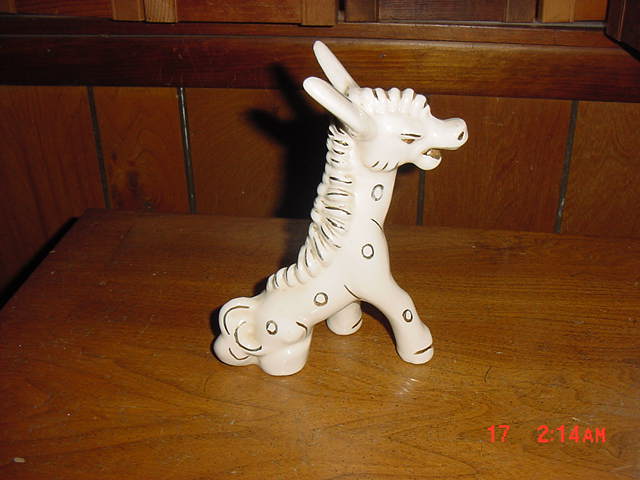
Donkiraffe?

Chris over at the Pottery Auction sends me a picture of a strange hoofed mammal:

Click this link to see a very strange pottery creature.
http://www.potteryauction.com/cgi-bin/merkatus.exe?lot=140674
Saw the scottie dog planters on your site (thanks) shall I send pics of the bottoms as someone requested?


In this case sending pics of the bottom probably wouldn't help, since he's got separate feet and no markings. Usually when a piece has one continuous bottom I can get a clue from what that looks like: the shape of the unglazed "feet" where the piece sat during firing is often a clue to the maker.

Grindley would have been my first guess for your animal, but after looking through the book I don't see anything like it. Also, the gold polka-dots I see on their animals in the book are either solid dots, or polka-dots in the shape of little padlocks. My second guess is California, although I don't have anything to back that up: there were so many California potteries that I've shied away from them for my collection. I'm afraid I'm stumped!